
The Complete GEO Action Map: One Checklist to Wrap Up the Series
The final installment of the GEO series distills everything into a single, ready-to-execute checklist, organized by priority from quick wins to long-term plays, with notes on how Shopify merchants can automate most of it with one tool.
The Complete GEO Action Map: One Checklist to Wrap Up the Series
This is the final post in the GEO series.
Over the previous four posts, we covered: why the rules changed, how to respond, how to configure Schema, and how to measure results.
This post introduces nothing new. It does just one thing: it turns every action you should take into a single checklist you can execute right away.
If you run a Shopify store, this one is especially useful—later on, we'll show you how to handle most of this checklist with a single tool, in one click.
Print it out, stick it on the wall, and cross off the items one by one.
First, one ground rule
GEO isn't a one-off project—it's an ongoing operation.
But you don't have to do everything at once. The checklist below is ordered by priority—from quick wins you can knock out today to long-term efforts that require sustained investment.
Getting started matters more than waiting until you feel "ready."
Phase 1: Take stock of where you stand
This step needs no tools at all—just 30 minutes.
- • [ ] Open ChatGPT, search for your brand name, and see how the AI describes you
- • [ ] Search your 3–5 core product terms in Perplexity and check whether your brand shows up
- • [ ] Search
site:yourdomain.comin Google to confirm your pages are being indexed properly - • [ ] Use Google's Rich Results Test to check the Schema status of your key product pages
- • [ ] Record the above results as your baseline (screenshots or a spreadsheet)
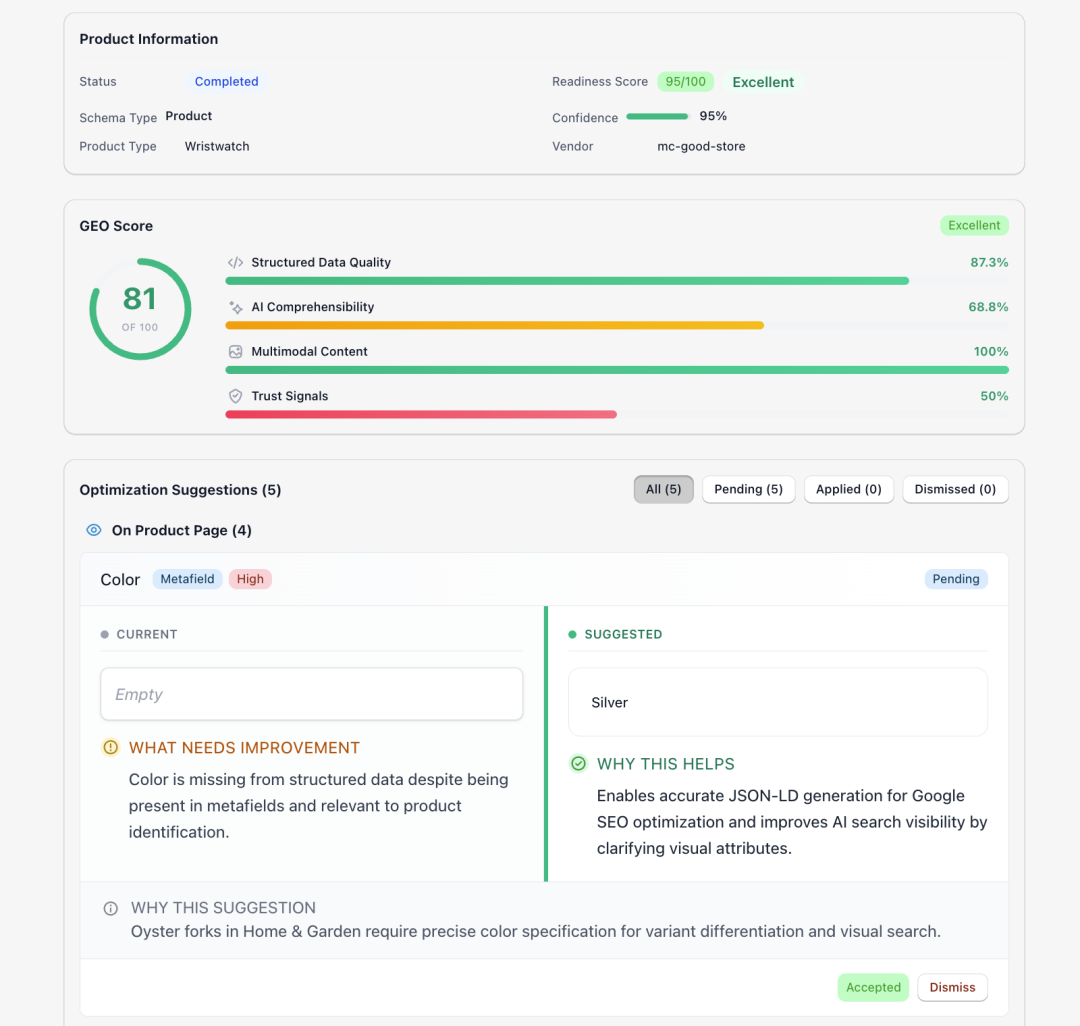
If you're on Shopify: you can install Geoify directly. It runs an AI analysis on every product in your store and gives you a GEO Score (0–100).
This score isn't arbitrary—it's a composite assessment across four dimensions:
- • Structured data (42 points)—whether Schema is present, whether nesting is correct, whether all properties are complete
- • AI readability (30 points)—content structure, FAQ coverage, long-tail question density
- • Multimedia content (20 points)—image quality and quantity, video, technical documentation
- • Trust signals (8 points)—certifications on display, customer reviews, case studies
Once the analysis is done, you can see at a glance which products are "0–49 points, urgent fixes needed" and which are "70+ points, just minor tweaks"—no need to check every page by hand. You'll have a complete GEO snapshot of your entire store within 30 minutes.
Phase 2: Fix the fundamentals
These are high-leverage, one-time actions—do them once and you won't have to keep worrying about them.
Content structure
- • [ ] Review your product pages: does each paragraph lead with its conclusion? Get rid of "First, we need to understand…"-style writing
- • [ ] Add an FAQ module to your 3–5 most important product pages (at least 5 real customer questions)
- • [ ] Make sure product descriptions cover: use cases, core specs, and clear differentiation
Schema structured data
- • [ ] Deploy
OrganizationSchema on your homepage, filling inname,url,logo, andsameAs - • [ ] Complete the
ProductSchema on product pages:name,description,offers(price/currency/availability), andaggregateRating - • [ ] Add
FAQPageSchema to your FAQ pages and product pages - • [ ] Validate with the Rich Results Test to make sure there are no errors
A note for Shopify merchants: Writing Schema by hand has two pain points—first, it's easy to get wrong (for example, putting price directly at the Product level instead of nesting it inside Offer, which Google won't recognize), and second, you have to keep it in sync every time your product data changes.
Here's how Geoify handles it: after analyzing each product, it automatically generates Schema.org-compliant JSON-LD with the correct nesting hierarchy (
Product > Offer > Seller,AggregateRating), and it pulls in your Metafields data too—syncing to Shopify in one click, with no code required. You can validate the results directly with Google's Rich Results Test.
LLMs.txt (an emerging standard—deploy now to get ahead)
- • [ ] Generate an
LLMs.txtfile in your site's root directory—this is a "manual" written specifically for AI search engines to read - • [ ] Spell out in the file: who your brand is, what you sell, and a list of URLs for your core products/collections/pages
Most competitors haven't done this step yet, so doing it first stakes out your position. Geoify has a built-in LLMs.txt configuration interface—enter your brand overview, core product categories, and key page URLs, and it automatically generates a properly formatted file and deploys it to your domain's root directory, with no code at any point.
Brand information consistency
- • [ ] Confirm that your brand name, official site URL, and description are perfectly consistent across all platforms (your website, Facebook, Instagram, LinkedIn, Google Business)
- • [ ] If you have a Wikipedia article or Wikidata entry, make sure the information is accurate
Phase 3: Build external presence
This is the part most easily overlooked, yet it has the biggest impact on GEO. AI cites you because it has seen you in multiple places—not just on your own website.
Review platforms
- • [ ] Create or build out your brand profile on Trustpilot
- • [ ] Send an email to recent customers inviting them to leave a review
- • [ ] If there are platforms that fit (G2, Capterra), complete your product listings
Community presence
- • [ ] Find 2–3 communities where your target users are active (Reddit, Facebook Groups, niche forums)
- • [ ] Observe for a week first to find genuine question threads
- • [ ] Take part in discussions in a genuine, valuable way—not hard selling, but helping people solve problems
Media coverage
- • [ ] Put together a list of 5–10 industry outlets or bloggers whose content gets indexed by AI
- • [ ] Prepare a short brand pitch (who you are, what problem you solve, whether you have data or case studies)
- • [ ] Goal: land at least 1 external mention or piece of coverage this month
Phase 4: Ongoing content operations
GEO's long-term moat comes from continuous output, not one-time optimization.
Building content clusters
- • [ ] Pin down your core differentiating themes (1–2 of them)
- • [ ] Plan 5–10 in-depth articles around each theme (product comparisons, use-case solutions, industry insights)
- • [ ] Every article should include: a direct conclusion paragraph, supporting data, a checklist or table, and an FAQ module
Content quality checklist (run through this before publishing each piece)
- • [ ] Does the first paragraph state the core conclusion?
- • [ ] Does it cite verifiable data sources?
- • [ ] Does it use lists, tables, or an FAQ format?
- • [ ] Is Schema deployed?
Phase 5: Monitor and iterate
- • [ ] Check brand-term clicks in GSC and compare against last month
- • [ ] Check changes in Direct traffic in GA4, watching new-visitor share and bounce rate
- • [ ] Manually search 5 target terms in ChatGPT / Perplexity / Gemini and record whether your brand appears
- • [ ] Review your Google Alerts notifications and tally up new external mentions
- • [ ] Adjust next month's content direction or backlink strategy based on the results
For Shopify merchants: In Geoify you can re-analyze products at any time, and after each round of optimization you can see exactly how each component of the GEO Score changed—whether it was structured data that improved or content coverage—so you're working from clear data, not gut feel.
One diagram to sum it up: the four pillars of GEO
                    被 AI 引用
                        ↑
        ┌───────────────┼───────────────┐
        │               │               │
    内容可引用       外部可信度       技术可读性
  (结构/数据/FAQ) (评测/媒体/社区) (Schema/索引)
        └───────────────┼───────────────┘
                        │
                   持续的存在感
              (内容集群 + 长期运营)
All four pillars are essential. If your technical setup is solid but you have no external mentions, AI won't trust you; if your content is great but the structure is a mess, AI can't extract it.
If you're a Shopify merchant: what Geoify can do for you
A significant portion of the checklist above can be handled by a tool instead of by hand.
We built a GEO optimization tool designed specifically for Shopify merchants—Geoify. What it does maps neatly onto the most time-consuming parts of the checklist:
① Store-wide GEO health scan
After installing, it syncs your product data, runs a comprehensive AI analysis on each product, and generates a GEO Score from 0 to 100. The score is made up of four dimensions: structured data (42 points), AI readability (30 points), multimedia content (20 points), and trust signals (8 points).
You can see directly which products are "0–49 points, needs urgent attention" and which are "70+ points, just minor tweaks"—the GEO status of your entire store, clear at a glance within 30 minutes.
② Automatic generation of Schema structured data
After analyzing each product, Geoify automatically generates Schema.org-compliant JSON-LD code, covering core types like Product, Organization, and FAQPage.
It handles nested structures correctly—Product → Offer → Seller, AggregateRating, additionalProperty—rather than stuffing price directly at the product level and triggering Google errors. Every Schema suggestion is tagged with a priority, and once accepted, it syncs to Shopify in one click, with no code changes.
③ 4–6 specific optimization suggestions per product
Beyond structured data, Geoify also offers content-level suggestions:
- • Is the description too short (under 50 words)?
- • Which key attributes are missing (material, SKU, GTIN)?
- • Is the product category too broad, hurting AI comprehension?
Each suggestion notes its type (category/content/SEO/Schema), priority, and estimated time, and you can choose to accept or ignore them one by one.
④ Automatic LLMs.txt configuration
Fill in your brand information, core product categories, and key page links, and Geoify automatically generates a properly formatted LLMs.txt file and deploys it to your domain's root directory. Most competitors haven't done this yet, so doing it now means staking out your position early.
⑤ Missing-data report + bulk fixes
It automatically scans your entire product catalog for products that are missing images, have empty descriptions, or have no price, ranks them by severity, jumps you straight to the relevant product to fix it, and tracks your improvement progress.
Here's one way to use it:
- • Day one: run a store-wide scan and get your GEO Score distribution
- • This week: work through the Schema suggestions for all 0–49 point products
- • This month: push products below 70 points over the passing line
- • Every month: re-analyze and review how the scores have changed
👉 Geoify - the AI search optimization tool for Shopify
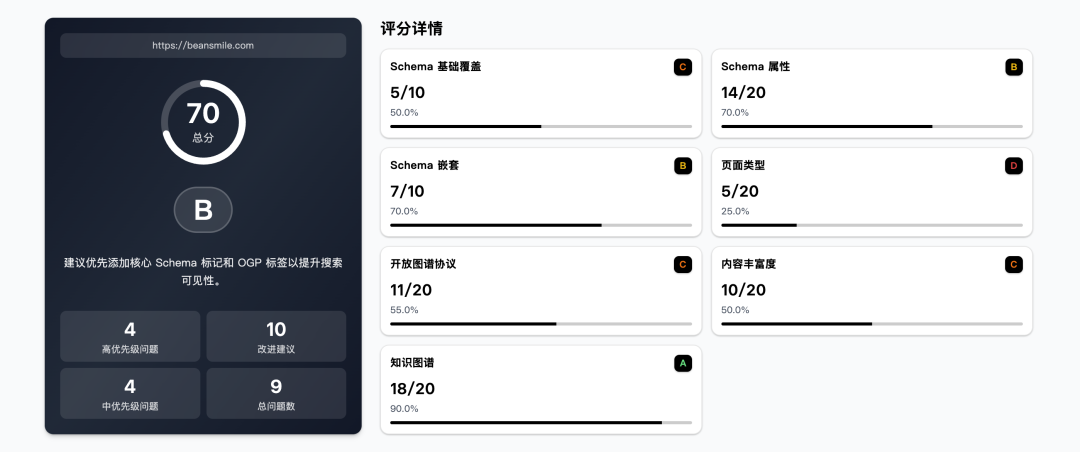
For now, Geoify is built specifically for Shopify merchants. If you're on a different website platform, we have another tool coming soon: GEO Scoring.
It's simple to use: enter your domain, wait for the analysis to finish, and you'll get a complete site-wide GEO report—overall score, grade, and a per-dimension breakdown (Schema coverage, OGP configuration, content structure, knowledge-graph signals). Every point deduction comes with a specific explanation: what's missing, how many points it costs, how high its priority is, and how to fix it—with copy-paste code snippets provided for some issues.
A final word
Doing GEO doesn't require a big team or a big budget.
What it requires is this: answering every question your customers genuinely ask in a clear, credible, data-backed way—and then getting those answers to show up in enough places.
When it comes to this, a small team can actually move faster and more flexibly than a big brand.
If you're a Shopify merchant, you can start here:
👉 Geoify - the AI search optimization tool for Shopify
Scan how likely your products are to be seen in ChatGPT, Perplexity, and Google SGE.
That brings the GEO series to a close for now, but the magic of data is only just beginning. If you hit a wall putting this into practice, I'll be waiting for you in the comments.

Series recap:
- • ① Was Your SEO All for Nothing? AI Search Is Rewriting the Rules of Traffic
- • ② What Did Brands Named by ChatGPT Do Right? A Hands-On GEO Checklist
- • ③ Why Can't AI Understand Your Product Pages? The Complete Guide to Schema Structured Data
- • ④ You've Done GEO Optimization—How Do You Know If It's Working?
- • ⑤ The Complete GEO Action Map: One Checklist to Wrap Up the Series (this post)
Originally published by 乐豆说